

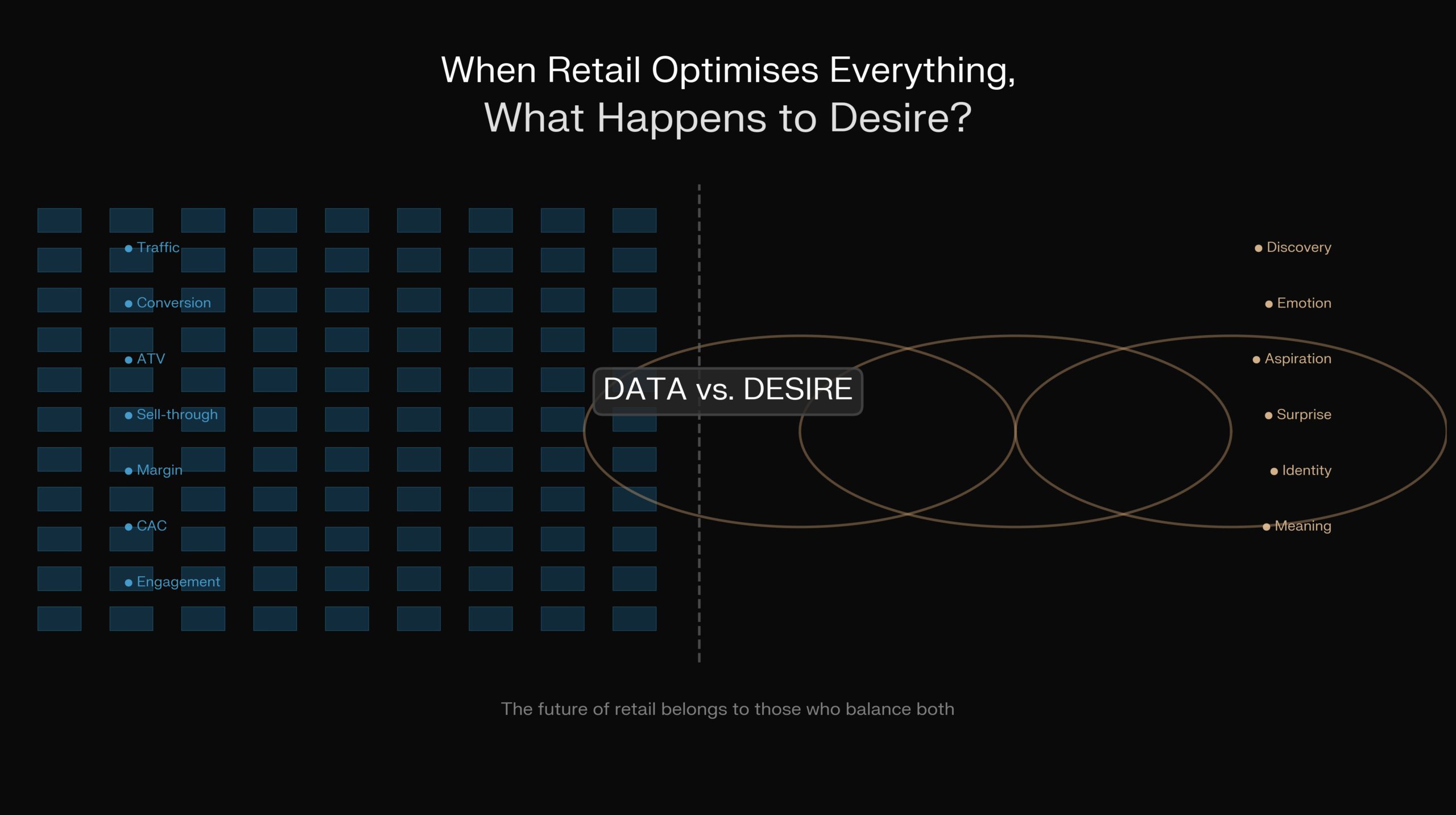
When Retail optimises everything, what Happens to desire?
Retail has never had access to as much information as it does today. And this is risky.
Customer behaviours can be tracked across channels. Demand can be forecast at SKU level. Prices can be adjusted in real time. Campaigns can be tested, measured and refined. AI can identify patterns that would have been impossible for human teams to detect only a few years ago.
It’s clear that this progress is valuable and data can improve availability, reduce waste, personalise interactions and help retailers make better commercial decisions.
But there is a risk.
When data analysis becomes excessive, retail can move from being data-informed to being data-controlled and at that point, analysis no longer supports decision-making, it starts to replace judgement, creativity and courage.
The result can be an industry that is increasingly efficient, but less desirable; increasingly measurable, but less meaningful; increasingly personalised, but less human.
The data paradox
The purpose of analysis is to create clarity, but many retail organisations are experiencing the opposite: they have more dashboards, more reports, more performance indicators and more sophisticated systems, but not necessarily better decisions.
This is the data paradox: the more information an organisation produces, the harder it may become to decide what truly matters.
A commercial team might analyse traffic, conversion, average transaction value, sell-through, returns, customer acquisition cost, repeat purchase, engagement, margin, stock availability and channel performance. Each metric may be valid individually; the problem emerges when every metric becomes a requirement for action.
Teams then spend more time explaining performance than improving it; decisions are postponed while people search for additional evidence; initiatives are challenged because they cannot yet demonstrate a sufficiently reliable return and managers become reluctant to commit to anything that cannot be defended through a spreadsheet.
This is analysis paralysis.
The organisation appears rigorous. In reality, it may be avoiding responsibility.
- What data can and cannot tell us
Data is exceptionally good at describing behaviours, telling us:
- What customers purchased.
- When they purchased.
- Which products performed best.
- Which channels generated conversion.
- Which messages created a response.
- Where friction exists in the customer journey.
- Which operational processes require improvement.
These insights are essential, but they do not answer every strategic question.
Data is less capable of telling us:
- What customers may desire in the future.
- Which new idea could create a category.
- Why a product has emotional meaning.
- What might make a brand more culturally relevant.
- Which experience a customer will remember years from now.
- When a company should deliberately do something unexpected.
Historical data is, by definition, rooted in the past: it can reveal patterns, but it cannot guarantee that the future will behave in the same way.
This matters enormously in fashion, luxury, beauty, hospitality and experiential retail, because in these sectors, customers do not buy only functional benefits, they buy identity, aspiration, emotion, belonging and discovery.
They are not always looking for a better version of what they already know, sometimes they are waiting to be surprised.
- The danger of optimising the past
When retailers rely too heavily on historical performance, they often reward familiarity.
Products that have already sold become easier to approve. Campaigns that have already worked receive more investment. Customer segments are targeted according to their previous behaviours.
New ideas are expected to prove their value before they have had the opportunity to create it, and this creates a subtle but powerful bias:
the organisation becomes better at repeating what it knows than at imagining what could be next.
Over time, creativity is replaced by optimisation.
The assortment becomes safer. Visual identity becomes more predictable. Marketing becomes more similar across competitors. Recommendations become narrower. Store teams are encouraged to follow established patterns rather than exercise judgement.
The brand may remain commercially active, but its capacity to generate desire begins to decline.
This is particularly dangerous for luxury brands: luxury cannot be reduced to availability, convenience or conversion; its value depends partly on tension: the space between what is known and what is discovered, between familiarity and surprise, between accessibility and aspiration.
If every customer is shown only what their previous behaviour predicts, personalisation can become a form of limitation. The customer is trapped inside their own history.
- From personalisation to confinement
Personalisation is often presented as the ideal customer experience, and in many cases, it is. Customers appreciate relevance, convenience and recognition.
But personalisation has a boundary.
If a retailer uses data only to show customers more of what they have already purchased or browsed, it may improve short-term conversion while reducing the opportunity for exploration. The customer experience becomes efficient, but repetitive.
A good client advisor does not merely show a customer what they have previously bought; a good client advisor may introduce a new designer, suggest different colours, connect a product to a new occasion or offer an unexpected alternative.
That is not a failure of personalization, it is a more sophisticated form of personalization, one that understands the customer well enough to expand their possibilities.
The best retail experiences combine relevance with surprise.
- The human cost of excessive measurement
The effect of over-analysis is not limited to product and marketing decisions. It also changes organisational behaviours.
When employees know that every decision will be evaluated through immediate metrics, they naturally become more cautious and they select options that are easy to measure and avoid initiatives whose benefits are uncertain, long-term or emotional.
This can damage the role of frontline teams.
Store colleagues, client advisors and customer service employees often possess valuable qualitative knowledge: they hear questions that do not appear in dashboards, they observe hesitation, excitement, disappointment and curiosity and they understand local context and individual customers.
However, if the organisation values only centrally generated data, this human intelligence is treated as anecdotal rather than strategic.
The irony is that retailers may invest heavily in artificial intelligence while underusing the intelligence of their own people: data should help frontline teams make better decisions, not reduce them to operators of a predetermined system.
- Performance is not the same as experience
Retail performance matters. Profitability matters. Productivity matters. A business cannot survive on creativity alone.
But performance metrics are not the same as customer experience.
A customer journey can produce a conversion and still feel uninspiring; a store can achieve its sales target and still weaken the brand; a campaign can deliver strong click-through rates and still fail to create lasting preference; a recommendation engine can increase basket size while making the customer feel understood only as a commercial opportunity.
This is why retailers need to distinguish between:
- Efficiency, which reduces waste and friction.
- Effectiveness, which achieves a defined commercial outcome.
- Experience, which shapes how the customer feels.
- Desirability, which creates preference, anticipation and emotional value.
The first two are generally easier to measure. The latter two are more difficult, but they are often what makes a brand distinctive.
If a business measures only what is easiest to quantify, it will gradually underinvest in what is hardest to measure and potentially most valuable.
Data should inform, not dictate
The alternative is not to reject analytics or return to intuition-only management.
That would be equally dangerous.
The challenge is to create a more intelligent partnership between data, human judgement and creativity.
A useful principle is:
Data should identify possibilities. Human judgement should interpret them. Creativity should make them desirable. Leadership should decide where to act.
This requires several changes in how retailers work.
Begin with the decision
Before asking what data is available, ask what decision needs to be made.
A clear decision question prevents the organisation from collecting information simply because it exists. It also helps teams distinguish between useful evidence and analytical distraction.
Separate optimisation from innovation
Existing operations should be continuously optimised. But innovation needs protected space.
A new concept, product or customer experience should not be evaluated by exactly the same criteria as a mature activity: early-stage ideas may need different measures – customer curiosity, engagement quality, earned attention, qualitative feedback or evidence of emotional resonance.
Combine data with human insight
Quantitative analysis should be complemented by store feedback, customer conversations, cultural observation, community insight and direct experience of the brand.
The question is not whether data or intuition is correct. The question is what each can reveal that the other cannot.
- Measure what creates meaning
Retailers should continue to measure sales, margin and productivity, but they should also pay attention to indicators of brand and customer value:
- Customer advocacy.
- Repeat engagement.
- Quality of client relationships.
- Discovery of new categories.
- Emotional response.
- Brand distinctiveness.
- Long-term customer value.
- Qualitative feedback from frontline teams.
Not everything meaningful can be reduced to one number. That does not make it unimportant.
Give people permission to challenge the model
A healthy data culture allows people to say:
“The evidence is incomplete, but we believe this is strategically important.”
That statement should not automatically be dismissed as intuition, it should prompt a disciplined discussion about assumptions, risks, experiments and learning; and the purpose of data is not to eliminate uncertainty, it is to help an organisation navigate uncertainty more intelligently.
- The role of AI
Artificial intelligence makes this debate even more important.
AI can accelerate analysis, identify patterns, automate decisions and generate content at enormous scale. But speed and volume do not necessarily produce originality.
If AI systems are trained primarily on historical behaviour and existing outputs, they may become excellent at reproducing what already exists, they can help retailers optimise a familiar formula while quietly reinforcing sameness.
The strategic question is therefore not simply: “What can AI automate?”
It is also: “What should remain human because it depends on imagination, empathy, taste, courage and responsibility?”
Retail leaders should use AI to remove administrative complexity, improve decision quality and free people to focus on higher-value work, but they should be careful not to use it as a substitute for creative direction or customer understanding.
AI can suggest, it can compare, it can predict, it can accelerate.
But desirability still requires a point of view.
The future belongs to balanced retailers
The strongest retailers will not be those that use the most data, they will be those that know where data is useful, where it is insufficient and where it must be challenged and they will use analytics to improve availability and service without allowing efficiency to define the entire customer relationship.
They will use personalisation to make experiences more relevant without making them predictable and they will use AI to enhance human capability without outsourcing judgement.
They will understand that customers are not only sources of behavioural information, but they are people with changing aspirations, emotions and imaginations.
Retail should not merely respond to demand, it should also create reasons to desire, discover and return.
The objective is not to choose between data and creativity, it is to build an organisation in which both can perform their proper roles:
Data helps us understand what is happening. Creativity helps us imagine what could happen. Leadership connects the two and turns insights into a compelling customer experience.
Because the future of retail will not be won by whoever analyses the past most precisely, it will be won by whoever uses knowledge, imagination, courage to create the future customers want to enter.
