

In my career journey is experienced that the core challenge of transformationis not just about changing systems or processes, it’s about changing how organizations think, collaborate, and decide. Yet, too often, transformation initiatives stumble because they are trapped in functional silos, governed by unilateral decision-making, or bogged down by bureaucratic delays.
But, successful transformations share a common blueprint: break down silos, establish shared governance between business and tech, and push decision-making authority to those closest to the action.
This isn’t just theory, it’s a pattern backed by real-world success stories and case studies.
So, what does this look like in practice?
And how can leaders design a model that balances speed, alignment, and accountability?
What the Research and Case Studies reveal.
1. Silos are the enemy of agility
Silos – whether organizational, informational, or cultural – stifle collaboration, slow decision-making, and breed inefficiency. When departments operate in isolation:
- Information doesn’t flow freely, leading to misalignment and duplicated efforts.
- Innovation suffers because cross-functional insights are lost.
- Coordination breaks down, making it harder to execute complex initiatives.
The solution? Structural and cultural integration: companies that actively dismantle silos – through cross-functional teams, shared goals, and unified communication channels – see faster execution, higher innovation rates, and better outcomes.
2. Joint Governance: Business + Tech = Success
Transformation cannot be an “IT project” or a “business initiative” in isolation. The most effective programs are co-owned by both sides, with:
- Shared KPIs that align business and tech objectives.
- Clear roles and responsibilities to avoid ambiguity.
- Collaborative decision-making to ensure both perspectives are represented.
Why does this work? Because technology without business context lacks direction, and business strategy without tech enablement lacks execution power. When both functions govern together, transformations are more holistic, realistic, and sustainable.
3. Decentralize Decisions – but not too far
One of the most compelling findings across studies is that decision-making should happen as close to the field as possible. Front-line teams – those interacting with customers, suppliers, and local markets – often have the best, most timely information. When they’re empowered to act:
- Speed increases (no waiting for approvals up the chain).
- Solutions are more practical (grounded in real-world constraints).
- Course corrections happen faster (reducing the risk of costly delays).
But there’s a catch: decentralization without guardrails can lead to fragmentation, inconsistency, or misalignment with strategic goals.
4. The role of central Leadership: Vision, Guardrails, and Coherence
While local empowerment is critical, central leadership still plays a non-negotiable role:
- Setting the vision and priorities (so everyone moves in the same direction).
- Allocating resources (ensuring initiatives are properly funded and staffed).
- Defining governance and metrics (to maintain coherence across decentralized teams).
Without this top-down framework, decentralization can devolve into chaos.
The Hybrid Model – the agile solution
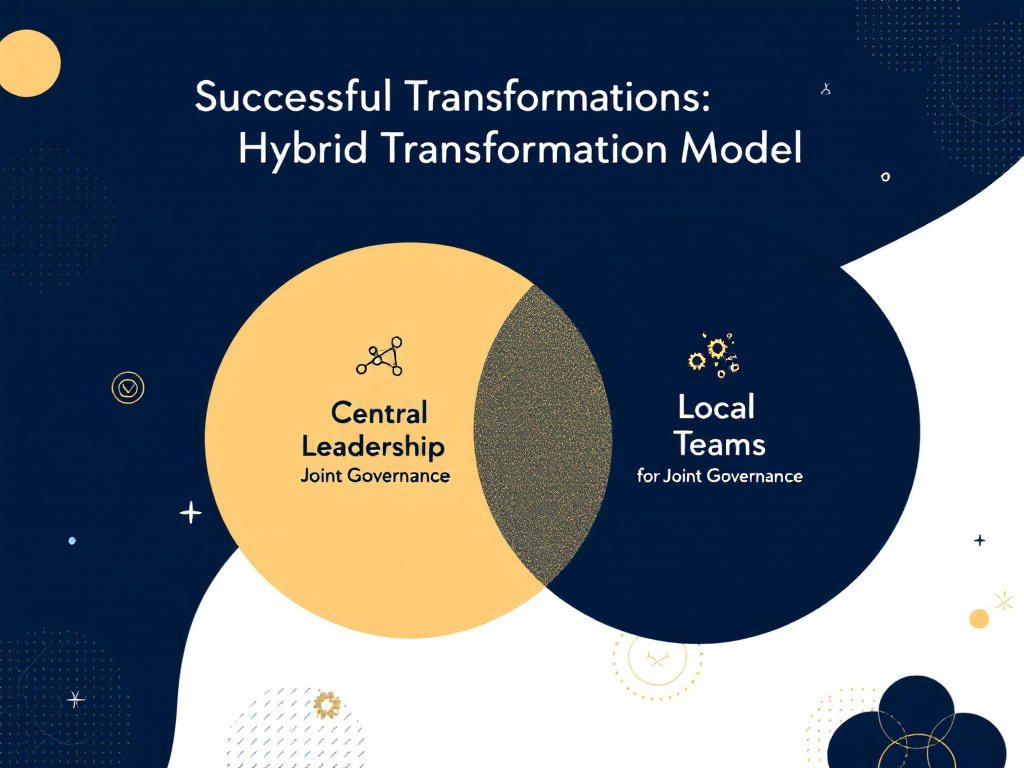
The strongest approach to transformation is not an either/or proposition – it’s a hybrid model that combines the best of centralization and decentralization:
| Central Leadership | Local Teams |
| Defines vision, strategy, and guardrails | Executes and adapts based on real-time insights |
| Allocates resources and budgets | Makes operational decisions close to the field |
| Ensures coherence and alignment | Innovates and problem-solves with agility |
| Sets shared KPIs and governance | Collaborates across functions (business + tech) |
Why the hybrid model works:
- Speed + Alignment: local teams move fast, but within a framework that keeps them aligned with the big picture.
- Innovation + Consistency: front-line autonomy fosters creativity, while central oversight ensures it doesn’t stray from strategic goals.
- Agility + Accountability: decisions are made where the information is best, but with clear accountability to leadership.
From my experience – some practical takeaways for Leaders.
If you’re leading or designing a transformation initiative, here’s how to apply this hybrid model:
1. Break the silos
- Create cross-functional teams (business + tech + operations) for key initiatives.
- Implement shared tools and platforms (e.g., collaborative workspaces, unified dashboards) to improve information flow.
- Foster a culture of transparency – encourage open communication across departments.
2. Establish joint Governance
- Define shared KPIs that both business and tech teams are accountable for.
- Clarify roles – who owns what? Who decides what? Avoid ambiguity.
- Hold regular alignment meetings to ensure both sides are synchronized.
3. Push decisions downward
- Empower local leaders to make operational calls (e.g., process adjustments, customer-facing changes).
- Provide training and context so front-line teams understand the “why” behind the strategy.
- Set clear escalation paths for decisions that require central input.
4. Maintain strong central Leadership
- Articulate a clear vision – what are you transforming toward?
- Define non-negotiables (e.g., compliance, brand standards, budget limits).
- Monitor progress with centralized reporting, but allow local flexibility in how goals are achieved.
My final thought: Transformation as a Team Sport
The most successful transformations are not top-down mandates, nor are they grassroots revolutions. They are collaborative efforts where:
- Central leadership sets the stage,
- Cross-functional teams co-create solutions,
- Local leaders execute with autonomy.
By breaking silos, sharing governance, and empowering those closest to the action, organizations can move faster, adapt better, and deliver lasting change.
So, the question for Leaders is no longer whether to transform – but how to design a model that unlocks the full potential of their people.
